
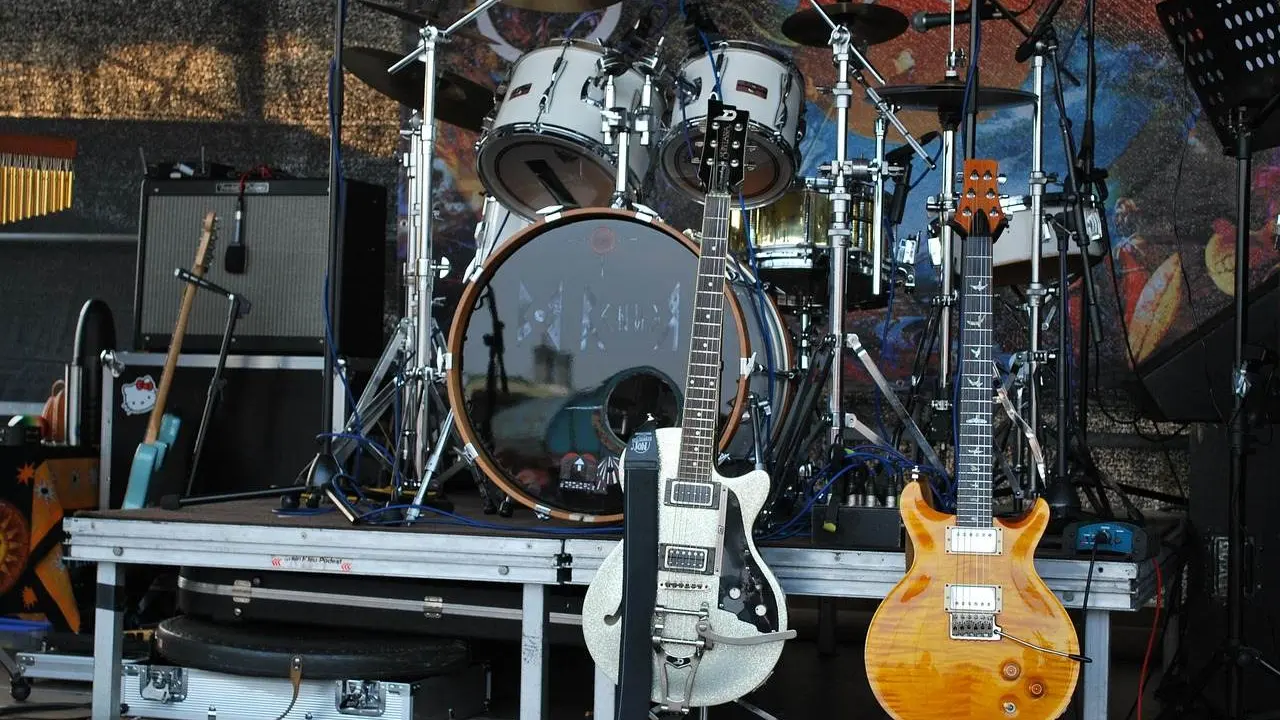
Rock duos are bands built on just two players, most often guitar and drums, that still manage to sound full. They get there through amplifier choices, effects, arrangement and a drummer who plays as a lead voice.
This page looks at how that works in practice. For the wider picture of the genre, start with the rock music guide.
The problem every duo has to solve
A standard rock band splits the work. One player covers rhythm, another takes solos, a bassist holds the low end and a drummer keeps time. A duo has to cover all of that with half the people, so every part of the sound has to do double duty. The guitar often plays riffs and low notes together, and the drums have to carry momentum and dynamics that a larger band would share around.
The Rock and Roll Hall of Fame puts the ambition plainly in its entry on the White Stripes, saying the band proved that a duo with defiant energy, catchy riffs, melodic savvy and unique style could captivate as much, if not more, than a large, complex ensemble.
Guitar and drums: the White Stripes and the Black Keys
The Hall of Fame describes the White Stripes as Jack White, a mastermind multi-instrumentalist and vocalist, and Meg White, a minimalist drummer who together crafted a sound greater than the sum of its parts. It says the band’s sound began as stripped-down, late ‘90s punk-blues minimalism, with electric guitar, banshee vocals and primal beats. Its visual identity was just as simple: the Hall notes that Meg White’s Ludwig drum set had its heads painted in a distinctive red and white design. The band was inducted in 2025.

The Black Keys came from a similar starting point. NPR describes a duo from Akron, Ohio, guitarist and singer Dan Auerbach and drummer Patrick Carney, who recorded their first album in Carney’s basement in 2002. The same NPR profile calls their sound a throwback to the days when Eric Clapton and Jimi Hendrix channeled American blues artists, a lineage covered on the page about blues rock.
Rolling Stone’s profile of the band says they started playing together in high school, and the reason was practical: Carney had a drum kit, Auerbach had a guitar. It also reports that it was always just the two of them, with no bassist and no producer.
Bass and drums: Royal Blood
Not every duo uses a guitar. Royal Blood is a pairing of bassist and singer Mike Kerr with drummer Ben Thatcher. Kerr told MusicRadar that how they wound up a duo was out of necessity, because he and Thatcher could not find anybody else to join. He added that he never thought he would end up in a two-piece band, but he likes the sound.
Rolling Stone describes the result: fattened with octave-pedal effects and droning harmonics, Kerr’s bass sounds like an alien army of guitars. In the same piece Kerr says he knew how much work the bass needed to do if there were only two people in the band.
The bass choice is deliberate. Kerr told MusicRadar that smaller basses give him more freedom to play them the way he would play a guitar. That is a useful clue to the duo approach in general: the instrument is chosen and processed so that one player covers the roles of several.
How duos build a bigger sound
Looking across these examples, several habits repeat.
- Effects and amplifier setups that widen the tone, such as octave pedals that add a second pitch to the line.
- Riffs that imply a chord and a bass line together, so no separate bass player is needed.
- Drumming that is simple and heavy, or busy and melodic, but never just a timekeeper.
- Arrangements with space, where silence and sudden loud sections create drama.
Kerr offers a contrast with the minimalist approach. He told MusicRadar that a lot of duos want to explore minimalism and space, whereas Royal Blood is the opposite: they want to be huge and full sounding. Both approaches are valid, and they show the format is flexible rather than a single sound.
The drummer’s role
In a duo the drummer is more than a metronome. With no bass guitar and no second guitar, the drum part supplies the pulse, the accents and much of the song’s shape. A heavy backbeat can stand in for the weight of a bass line, while fills mark the points where a larger band would add a new instrument. The Hall of Fame’s phrase for Meg White, a minimalist drummer, shows one answer: strip the part back so that every hit counts.
The two players also have to listen to each other closely. There is no third voice to cover a mistake or smooth over a change of tempo, so the guitarist or bassist and the drummer tend to lock together on stops, starts and sudden changes in volume. That tight interplay is part of what draws listeners to the format, and it is why many duos sound most convincing live.
Why the format keeps coming back
The appeal is practical as well as musical. A two-piece band is easy to move, easy to book into a small room and easy to organize. It can record in a basement, as the Black Keys’ first album shows, and it can later scale up to larger stages without changing its basic line-up. The format also puts the songwriting in plain view. With so few parts, a weak riff has nowhere to hide, which pushes duos to write memorable hooks.
It also gives a band a clear identity. Audiences can see exactly who is making which sound, and the costume, the colour scheme or the gear can become part of the brand, as the red and white drums did for the White Stripes. Each new generation of duos works from the same basic limit, then finds its own way around it.
Studio versus stage
On stage a duo has nowhere to hide, so timing between the two players matters a great deal. In the studio the options widen. The Hall of Fame says the White Stripes’ later years brought expanded arrangements, studio overdubbing, country folk influences and piano-driven songs, and that all of it eventually fed the anthemic, much-sampled song “Seven Nation Army”.
That shift shows a common path: a stripped-down live identity, then a recorded sound that adds layers while keeping the core of two players. Readers interested in Belgian rock can also read the notes on tattooed smiles, a separate page about a Belgian rock track.
What to listen for
When you hear a duo record, try focusing on one instrument at a time. Follow the drums for a full verse, then switch to the guitar or bass and notice how often it plays chords and a bass line at once. Then listen to the gaps. The spaces between hits are part of the arrangement, and they are one reason a duo can feel tense and exciting even with so few parts.
Frequently asked questions
What counts as a rock duo?
Show answer
A rock duo is a band of two players. Guitar and drums is the most common mix, as with the White Stripes and the Black Keys, though Royal Blood uses bass and drums.
How do duos sound so full without a bassist?
Show answer
They rely on effects, amplifier setups and riffs that suggest a chord and a bass line at the same time. Royal Blood, for example, uses octave pedals so that bass parts sound like guitars.
Are duos limited to blues-based rock?
Show answer
No. The White Stripes and the Black Keys both draw on blues, but the format suits any style that works with a small, direct sound.