

How electric guitars work comes down to electromagnetism: a pickup under the strings turns string vibration into a tiny electrical signal, and an amplifier makes it loud enough to drive a speaker.
This page walks through each step of that chain. For the wider picture of the music built on this instrument, see the rock music guide on this site.
From vibrating string to electrical signal
An acoustic guitar is loud because its hollow body joins in. As Explain that Stuff puts it, the wooden body of the guitar vibrates and the air inside the body vibrates too, and those vibrations amplify the string sound.
An electric guitar uses a different route. The same explainer says the body of an electric guitar is much less important in producing and amplifying the sound, and that all it really has to do is hold the strings so they are long and tight enough. Most of the sound comes from the pickups, which sit under the strings, and from the circuit and amplifier connected to them.
The physics behind this is electromagnetic induction. A university physics reference, HyperPhysics from Georgia State University, explains that the motion of the steel string close to the magnetic core of the coil changed the magnetic flux in the coil, generating a varying voltage by Faraday’s law. In plain terms, a moving metal string next to a magnet produces a small, changing electrical signal that follows the string’s motion.
Inside a pickup
A pickup is simple in concept. According to Explain that Stuff, each one consists of one or more magnets with hundreds or thousands of coils of very thin wire wrapped around them. The magnets create a field that reaches the strings, and the vibrating strings disturb that field, which pushes a small current through the wire.
The signal is far too weak to be heard directly. The pickups feed an electrical circuit and an amplifier, which boosts the small electric current and sends it on to a loudspeaker. The same source adds that the amplifier and loudspeaker are usually built into a single unit, the familiar guitar amp.
One consequence follows from the physics. A string produces a signal only while it moves, so once the string stops vibrating, the sound stops. In that respect an electric guitar behaves like an acoustic one, even though the sound-making machinery differs.
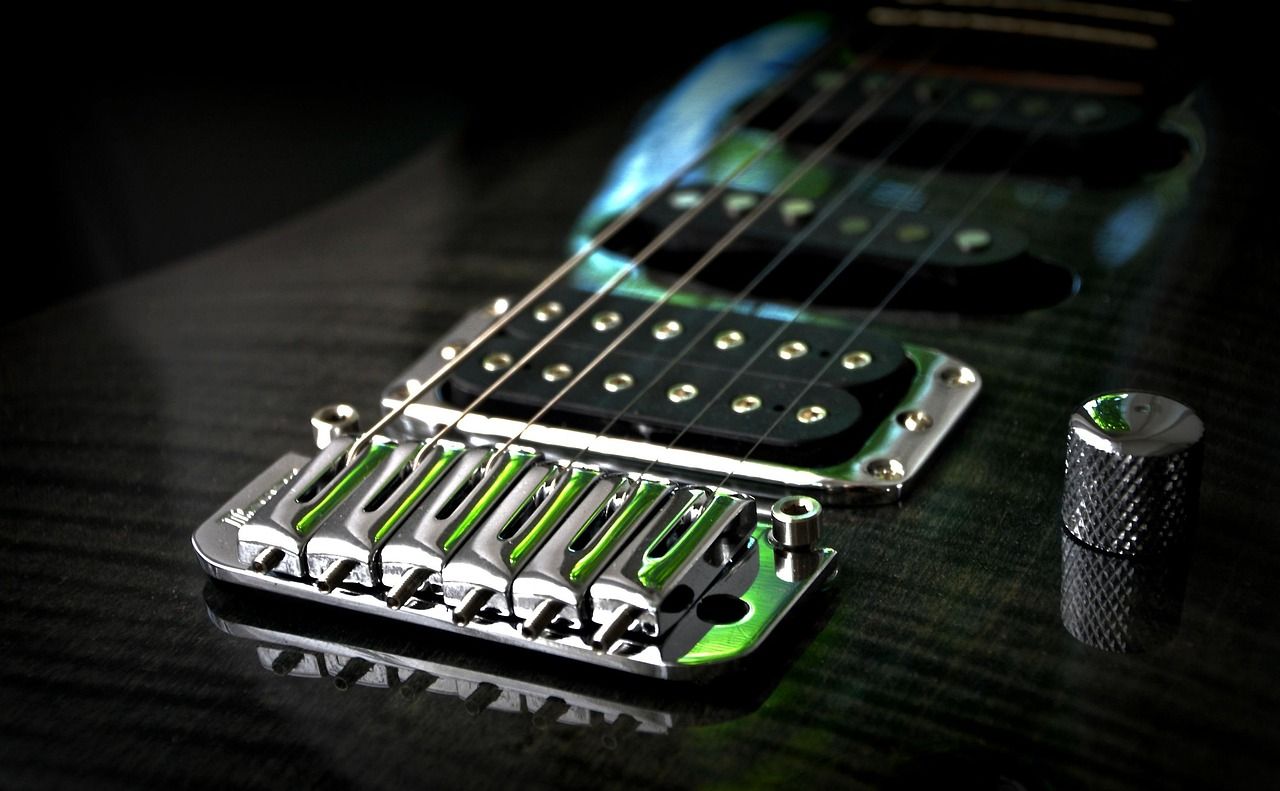
Single coils and humbuckers
Early pickups had a drawback. HyperPhysics notes that single-coil pickups were prone to pick up stray 60Hz hum voltages from electrical circuits around them.
The reason is straightforward. Explain that Stuff says a simple pickup with a single coil of wire is just as good at picking up stray electrical energy from power supplies and other interference as it is at picking up the string, so unwanted background noise can reach the amplifier along with the music. A guitar that sits near other electrical equipment shows the problem most clearly.
The fix was the humbucking pickup, which uses a pair of coils. Explain that Stuff describes how each coil is wired so that stray hum it captures from nearby electrical equipment is cancelled out by the other coil, which also captures more of the string signal. Explain that Stuff adds that the arrangement captures double the signal from the moving strings, producing a richer sound.
Not every pickup works magnetically. HyperPhysics says the piezoelectric effect can also be used for guitar pickups and that such pickups are often used for acoustic guitars. It also says optical pickups came into use in the 1990s for bass guitars.
Controls and the amplifier
Between the pickups and the amp sits a small circuit. Explain that Stuff says it usually contains volume and tone controls, which let a player shape the basic sound by turning knobs on the guitar body. More complex circuits can be added to change the sound further.
The amplifier is the last link in that chain. Everything upstream, from the pickup to the controls on the guitar body, shapes the signal before the amp boosts it and passes it to the speaker.
The main parts of the instrument
Several parts work together with the pickups. According to Explain that Stuff, the bridge supports the strings so they vibrate freely clear of the case, tuning pegs make strings looser or tighter to adjust pitch, and an output jack connects the guitar to the amplifier. The strings run along the neck and over the pickups, so each part has a clear job in the signal path.
The same page notes that most guitars have two or more pickups, which create a variety of different effects. Typically one sits near the bridge and another near the bottom of the neck, so a player can switch between them to change the tone. It adds that the way a pickup is constructed can make a dramatic difference to the sound the guitar produces, since magnet materials, the number of coils, pickup shape and wire thickness all alter the result.
Body materials are flexible as well. The explainer says early electric guitars were made from all kinds of materials, including molded Bakelite and sheets of soldered brass. That variety makes sense once the pickups, rather than the hollow body, are responsible for most of the sound.
A short history of the pickup
The idea is nearly a century old. Explain that Stuff says electric guitars that use pickups in this way were invented in the early 1930s by George Beauchamp, and it cites his patent for an electrical stringed musical instrument, filed June 2, 1934 and issued August 10, 1937.
Others refined the design. The same page shows a pickup patent from Clarence Leo Fender and Clayton Orr Kauffman, filed September 26, 1944 and issued December 7, 1948. From those early patents grew the solid-body designs that rock bands adopted.
Feedback, effects and the sound of rock
Once the signal is electrical, it can be changed. The Rock and Roll Hall of Fame says the Jimi Hendrix Experience revolutionized electric guitar playing by expanding on blues by incorporating feedback, extended improvisation and a distinctively fluid technique, and that the group pioneered recording techniques such as panning, backmasking and phasing.
That kind of experimentation is a large part of what psychedelic rock is remembered for. Readers who want to see how stripped-back bands used the same equipment can also read about garage rock on this site, a style built on guitar-driven bands.
Frequently asked questions
Does an electric guitar make sound without an amplifier?
Show answer
Very little. The strings still vibrate and can be heard faintly, but the loud sound comes from the pickups, circuit and amplifier working together.
What does a pickup actually do?
Show answer
It is a magnet wrapped in thin wire that turns the movement of a steel string into a small electrical signal, which then goes to the amplifier.
Why do some pickups hum?
Show answer
Single-coil pickups can pick up stray interference from nearby electrical circuits. Humbucking pickups use a pair of coils wired to cancel that hum.
Does the wood of the body matter?
Show answer
It matters less than on an acoustic guitar. The body mainly holds the strings long and tight enough, while the pickups and amplifier produce most of the sound.